DDIM vs DDPM
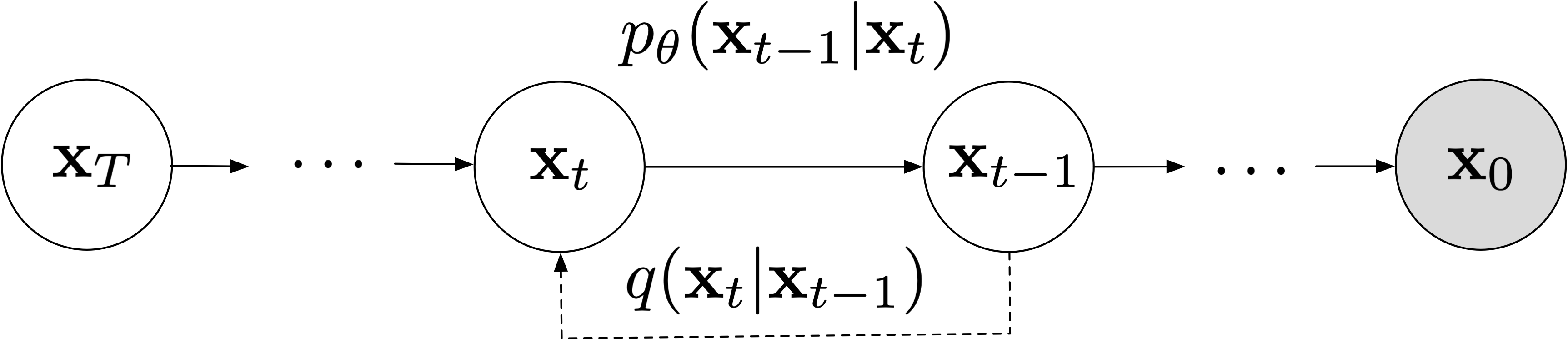
Diffusion models have emerged as a powerful class of deep generative models, particularly excelling in image synthesis tasks. This article delves into a comprehensive comparison of two significant variants: Denoising Diffusion Probabilistic Models (DDPM) and Denoising Diffusion Implicit Models (DDIM).
DDPM #
DDPM, introduced by Ho et al. in their 2020 paper “Denoising Diffusion Probabilistic Models,” is grounded in the principles of non-equilibrium thermodynamics. The model defines a Markov chain of diffusion steps that gradually add Gaussian noise to data, and then learns to reverse this process. Here’s a simplified pseudocode representation of the DDPM sampling process:
def sample_ddpm(num_steps):
    x = random_noise()
    for t in reversed(range(num_steps)):
        z = random_noise() if t > 1 else 0
        noise_pred = denoise_fn(x, t)
        x = (1 / sqrt(1 - beta[t])) * (x - (beta[t] / sqrt(1 - alpha_bar[t])) * noise_pred) + sqrt(beta[t]) * z
    return x
In this pseudocode, beta represents the noise schedule, alpha_bar is the cumulative product of (1 - beta), and denoise_fn is the learned denoising function.
DDPM is characterized by its Markovian nature, where each step depends only on the immediately preceding step. It typically employs a fixed number of steps, usually around 1000, for the denoising process. The generation process in DDPM involves stochastic sampling, drawing from probability distributions at each step. This approach generally yields high-quality samples but at the cost of computational intensity due to the large number of steps involved.
DDIM #
DDIM, proposed by Song et al. in their 2020 paper “Denoising Diffusion Implicit Models,” builds upon DDPM while introducing significant modifications to the generative process. DDIM introduces a non-Markovian inference process. Here’s a simplified pseudocode representation of the DDIM sampling process:
def sample_ddim(num_steps, eta):
    x = random_noise()
    for t in reversed(range(num_steps)):
        noise_pred = denoise_fn(x, t)
        alpha = alpha_bar[t]
        alpha_next = alpha_bar[t-1] if t > 0 else 1.0
        sigma = eta * sqrt((1 - alpha / alpha_next) * (1 - alpha_next) / (1 - alpha))
        z = random_noise() if t > 1 else 0
        x = sqrt(alpha_next) * (x - sqrt(1 - alpha) * noise_pred) / sqrt(alpha)
        x = x + sqrt(1 - alpha_next - sigma**2) * noise_pred + sigma * z
    return x
In this pseudocode, eta is a hyperparameter controlling the stochasticity of the sampling
process. When eta = 0, the process becomes deterministic.
The key advancements in DDIM include its non-Markovian process, where each step can depend on multiple previous
steps, and the option for deterministic sampling by setting eta to 0. Perhaps most notably, DDIM allows
for flexible sampling steps, capable of generating samples using significantly fewer steps (e.g., 10-100) compared to DDPM.
When comparing the two models, several key differences emerge. In terms of sampling efficiency, DDPM requires a fixed number of steps, resulting in slower generation. DDIM, on the other hand, allows for accelerated sampling with fewer steps, significantly reducing generation time. This efficiency gain in DDIM comes with a potential trade-off in sample quality, especially at very low step counts, though it can generally maintain comparable quality to DDPM.
The latent space properties of these models also differ significantly. DDPM’s stochastic nature makes it challenging to manipulate the latent space directly. In contrast, DDIM’s deterministic option allows for more controlled latent space manipulation, enabling operations like interpolation.
That last point is the one worth seeing directly. Below, both samplers run on a
toy target — eight Gaussian modes on a ring — with no trained network at
all. Because the target is a known mixture, the score of every noised marginal
is available in closed form, so eps_hat is exact. Whatever the samplers do
here is the sampler’s doing and nothing else.
Watch the re-run drift readout, which re-runs the chain from the identical
starting latent with a different noise stream. At eta = 0 it is exactly zero:
the same latent always produces the same sample, which is precisely what makes
DDIM latents interpolable. Push eta to 1 and it jumps to around 1.9 — the
latent no longer determines anything.
One honest caveat, since the widget will show it to you anyway: with an exact score, DDPM is not worse than DDIM. Over 2000 samples at 30 steps it is actually slightly tighter (mean distance to a mode centre 0.126 against 0.143). The efficiency advantage described above is real in practice, but it comes from how a learned network’s errors compound under a stochastic sampler — it is not a property of the update rule by itself. Determinism is.
The derivations behind the pseudocode #
The two samplers above look like magic formulas, so in this section I want to derive every coefficient in them. I use the notation of the DDPM paper throughout. One warning before starting: the DDIM paper writes $\alpha_t$ for the quantity that DDPM calls $\bar\alpha_t$. I translate everything to the DDPM convention so the two halves of this post line up.
The forward process and its closed form #
Fix a variance schedule $\beta_1, \dots, \beta_T \in (0, 1)$ and define $\alpha_t = 1 - \beta_t$ and $\bar\alpha_t = \prod_{s=1}^{t} \alpha_s$. The forward (noising) process is a Markov chain that starts at a data point $x_0 \sim q(x_0)$ and adds a little Gaussian noise at each step:
$$q(x_t \mid x_{t-1}) = \mathcal{N}\big(x_t;\ \sqrt{\alpha_t}\, x_{t-1},\ \beta_t I\big), \qquad q(x_{1:T} \mid x_0) = \prod_{t=1}^{T} q(x_t \mid x_{t-1}).$$
The useful fact is that we never need to run this chain step by step: the marginal at any $t$ has a closed form. Write one step as $x_t = \sqrt{\alpha_t}\, x_{t-1} + \sqrt{1-\alpha_t}\, \epsilon_{t-1}$ with $\epsilon_{t-1} \sim \mathcal{N}(0, I)$, and unroll it once:
$$x_t = \sqrt{\alpha_t \alpha_{t-1}}\, x_{t-2} + \sqrt{\alpha_t (1-\alpha_{t-1})}\, \epsilon_{t-2} + \sqrt{1-\alpha_t}\, \epsilon_{t-1}.$$
The two noise terms are independent zero-mean Gaussians, so their sum is a Gaussian whose variance is the sum of the variances, $\alpha_t - \alpha_t\alpha_{t-1} + 1 - \alpha_t = 1 - \alpha_t\alpha_{t-1}$. The pattern is clear, and induction on $t$ gives
$$q(x_t \mid x_0) = \mathcal{N}\big(x_t;\ \sqrt{\bar\alpha_t}\, x_0,\ (1-\bar\alpha_t) I\big),$$
or, as a sampling recipe,
$$x_t = \sqrt{\bar\alpha_t}\, x_0 + \sqrt{1-\bar\alpha_t}\, \epsilon,\qquad \epsilon \sim \mathcal{N}(0, I).$$
Because $\bar\alpha_T \approx 0$ for a sensible schedule, $q(x_T \mid x_0)$ is almost exactly $\mathcal{N}(0, I)$ regardless of $x_0$, which is why sampling starts from pure noise.
The posterior $q(x_{t-1} \mid x_t, x_0)$ #
The reverse conditional $q(x_{t-1} \mid x_t)$ is intractable, because it depends on the whole data distribution. Conditioned on $x_0$, though, it is an easy Gaussian. By Bayes and the Markov property,
$$\begin{aligned} q(x_{t-1} \mid x_t, x_0) &= \frac{q(x_t \mid x_{t-1})\, q(x_{t-1} \mid x_0)}{q(x_t \mid x_0)} \\ &\propto \exp\!\Big(-\frac{1}{2}\Big[ \frac{\|x_t - \sqrt{\alpha_t}\, x_{t-1}\|^2}{\beta_t} + \frac{\|x_{t-1} - \sqrt{\bar\alpha_{t-1}}\, x_0\|^2}{1-\bar\alpha_{t-1}} \Big]\Big). \end{aligned}$$
The exponent is quadratic in $x_{t-1}$, so we can read off the precision (the coefficient of $\|x_{t-1}\|^2$) and the linear term, and then complete the square. The precision is
$$\frac{\alpha_t}{\beta_t} + \frac{1}{1-\bar\alpha_{t-1}} = \frac{\alpha_t - \bar\alpha_t + \beta_t}{\beta_t (1-\bar\alpha_{t-1})} = \frac{1-\bar\alpha_t}{\beta_t (1-\bar\alpha_{t-1})},$$
using $\alpha_t (1-\bar\alpha_{t-1}) = \alpha_t - \bar\alpha_t$ and $\alpha_t + \beta_t = 1$. Dividing the linear term $\frac{\sqrt{\alpha_t}}{\beta_t} x_t + \frac{\sqrt{\bar\alpha_{t-1}}}{1-\bar\alpha_{t-1}} x_0$ by this precision gives the mean, so
$$q(x_{t-1} \mid x_t, x_0) = \mathcal{N}\big(x_{t-1};\ \tilde\mu_t(x_t, x_0),\ \tilde\beta_t I\big),$$
$$\tilde\mu_t(x_t, x_0) = \frac{\sqrt{\bar\alpha_{t-1}}\,\beta_t}{1-\bar\alpha_t}\, x_0 + \frac{\sqrt{\alpha_t}\,(1-\bar\alpha_{t-1})}{1-\bar\alpha_t}\, x_t, \qquad \tilde\beta_t = \frac{1-\bar\alpha_{t-1}}{1-\bar\alpha_t}\, \beta_t.$$
Now substitute $x_0 = (x_t - \sqrt{1-\bar\alpha_t}\,\epsilon)/\sqrt{\bar\alpha_t}$ from the closed form. The $x_t$ coefficient collapses to $\frac{\beta_t + \alpha_t - \bar\alpha_t}{\sqrt{\alpha_t}(1-\bar\alpha_t)} = \frac{1}{\sqrt{\alpha_t}}$, and the mean becomes
$$\tilde\mu_t = \frac{1}{\sqrt{\alpha_t}}\Big(x_t - \frac{\beta_t}{\sqrt{1-\bar\alpha_t}}\, \epsilon\Big).$$
That is exactly the update in sample_ddpm above, with the true noise
$\epsilon$ replaced by the network’s guess noise_pred.
From the ELBO to the simple $\epsilon$-loss #
The model is a reverse Markov chain $p_\theta(x_{0:T}) = p(x_T)\prod_{t=1}^{T} p_\theta(x_{t-1} \mid x_t)$ with $p(x_T) = \mathcal{N}(0, I)$ and $p_\theta(x_{t-1} \mid x_t) = \mathcal{N}(x_{t-1};\ \mu_\theta(x_t, t),\ \sigma_t^2 I)$, where $\sigma_t^2$ is fixed (Ho et al. use $\sigma_t^2 = \beta_t$ or $\sigma_t^2 = \tilde\beta_t$). The forward chain plays the role of the variational posterior, so Jensen’s inequality gives the usual bound
$$-\log p_\theta(x_0) \le \mathbb{E}_{q}\Big[-\log \frac{p_\theta(x_{0:T})}{q(x_{1:T} \mid x_0)}\Big].$$
Rewrite each forward factor for $t \ge 2$ with Bayes, $q(x_t \mid x_{t-1}) = q(x_t \mid x_{t-1}, x_0) = q(x_{t-1} \mid x_t, x_0)\, q(x_t \mid x_0) / q(x_{t-1} \mid x_0)$. The ratio $q(x_t \mid x_0)/q(x_{t-1} \mid x_0)$ telescopes across the product, and the bound splits into a sum of KL divergences:
$$\mathbb{E}_q\Big[ \underbrace{D_{\mathrm{KL}}\big(q(x_T \mid x_0)\,\|\,p(x_T)\big)}_{L_T} + \sum_{t=2}^{T} \underbrace{D_{\mathrm{KL}}\big(q(x_{t-1} \mid x_t, x_0)\,\|\,p_\theta(x_{t-1} \mid x_t)\big)}_{L_{t-1}} \underbrace{-\log p_\theta(x_0 \mid x_1)}_{L_0} \Big].$$
$L_T$ has no parameters. Each $L_{t-1}$ compares two Gaussians with the same fixed isotropic covariance, so it is a scaled squared distance between means:
$$L_{t-1} = \mathbb{E}_q\Big[\frac{1}{2\sigma_t^2}\,\big\|\tilde\mu_t(x_t, x_0) - \mu_\theta(x_t, t)\big\|^2\Big] + C.$$
Since the target mean has the form $\frac{1}{\sqrt{\alpha_t}}(x_t - \frac{\beta_t}{\sqrt{1-\bar\alpha_t}}\epsilon)$ and $x_t$ is an input to the network, the natural choice is to give $\mu_\theta$ the same form and let the network predict only the noise: $\mu_\theta(x_t, t) = \frac{1}{\sqrt{\alpha_t}}\big(x_t - \frac{\beta_t}{\sqrt{1-\bar\alpha_t}}\epsilon_\theta(x_t, t)\big)$. The $x_t$ terms cancel inside the norm, leaving
$$L_{t-1} - C = \mathbb{E}_{x_0, \epsilon}\Big[ \frac{\beta_t^2}{2\sigma_t^2\, \alpha_t\, (1-\bar\alpha_t)}\, \big\|\epsilon - \epsilon_\theta\big(\sqrt{\bar\alpha_t}\, x_0 + \sqrt{1-\bar\alpha_t}\, \epsilon,\ t\big)\big\|^2 \Big].$$
Ho et al. found that dropping the weight in front, and sampling $t$ uniformly, trains better. That gives the loss everyone actually uses:
$$L_{\text{simple}}(\theta) = \mathbb{E}_{t \sim \mathcal{U}\{1,\dots,T\},\ x_0 \sim q,\ \epsilon \sim \mathcal{N}(0, I)} \Big[\big\|\epsilon - \epsilon_\theta\big(\sqrt{\bar\alpha_t}\, x_0 + \sqrt{1-\bar\alpha_t}\, \epsilon,\ t\big)\big\|^2\Big].$$
Two things are worth pointing out. First, the loss only ever touches the marginals $q(x_t \mid x_0)$, never the joint chain. Second, $\epsilon_\theta$ is a scaled score: by Tweedie’s formula the optimal noise predictor satisfies $\nabla_{x_t} \log q(x_t) = -\epsilon^*(x_t, t)/\sqrt{1-\bar\alpha_t}$. Both facts matter for DDIM.
DDIM: a non-Markovian family with the same marginals #
Because $L_{\text{simple}}$ only depends on $q(x_t \mid x_0)$, any forward process with those marginals is trained by exactly the same objective. Song et al. construct a whole family of them, indexed by a vector of standard deviations $\sigma \in \mathbb{R}_{\ge 0}^{T}$:
$$q_\sigma(x_{t-1} \mid x_t, x_0) = \mathcal{N}\Big(x_{t-1};\ \sqrt{\bar\alpha_{t-1}}\, x_0 + \sqrt{1-\bar\alpha_{t-1}-\sigma_t^2}\cdot \frac{x_t - \sqrt{\bar\alpha_t}\, x_0}{\sqrt{1-\bar\alpha_t}},\ \sigma_t^2 I\Big).$$
The mean is chosen so that marginals are preserved. Suppose $x_t = \sqrt{\bar\alpha_t}\, x_0 + \sqrt{1-\bar\alpha_t}\,\epsilon$. Then the fraction in the mean is exactly $\epsilon$, so a draw from $q_\sigma$ is $\sqrt{\bar\alpha_{t-1}}\, x_0 + \sqrt{1-\bar\alpha_{t-1}-\sigma_t^2}\,\epsilon + \sigma_t z$ with independent $z \sim \mathcal{N}(0, I)$. Its variance is $(1-\bar\alpha_{t-1}-\sigma_t^2) + \sigma_t^2 = 1-\bar\alpha_{t-1}$. Starting from $q_\sigma(x_T \mid x_0) = \mathcal{N}(\sqrt{\bar\alpha_T}\, x_0, (1-\bar\alpha_T) I)$ and inducting downwards, every marginal is $q_\sigma(x_t \mid x_0) = \mathcal{N}(\sqrt{\bar\alpha_t}\, x_0, (1-\bar\alpha_t) I)$, the same as DDPM. The forward process implied by Bayes, $q_\sigma(x_t \mid x_{t-1}, x_0)$, still depends on $x_0$. That is what “non-Markovian” means here.
To generate, we replace the unknown $x_0$ with the network’s prediction $\hat x_0 = (x_t - \sqrt{1-\bar\alpha_t}\,\epsilon_\theta(x_t, t))/\sqrt{\bar\alpha_t}$:
$$x_{t-1} = \sqrt{\bar\alpha_{t-1}}\, \hat x_0 + \sqrt{1-\bar\alpha_{t-1}-\sigma_t^2}\; \epsilon_\theta(x_t, t) + \sigma_t z, \qquad \sigma_t(\eta) = \eta\, \sqrt{\frac{1-\bar\alpha_{t-1}}{1-\bar\alpha_t}}\,\sqrt{1-\frac{\bar\alpha_t}{\bar\alpha_{t-1}}}.$$
These are the three lines of sample_ddim. Since
$1 - \bar\alpha_t/\bar\alpha_{t-1} = \beta_t$, at $\eta = 1$ we get
$\sigma_t^2 = \tilde\beta_t$ and the step coincides with the DDPM posterior
step (in its $\sigma_t^2 = \tilde\beta_t$ variant). At $\eta = 0$ the noise term
vanishes and sampling is a deterministic map from $x_T$ to $x_0$. Since
only the marginals matter, the same derivation holds on any increasing
subsequence $\tau_1 < \dots < \tau_S$ of $\{1, \dots, T\}$ with $\bar\alpha$
evaluated on the subsequence. That is where DDIM’s step skipping comes from.
$\eta = 0$ is an Euler step of the probability-flow ODE #
Divide the deterministic update by $\sqrt{\bar\alpha_{t-1}}$ and define $\kappa_t = \sqrt{(1-\bar\alpha_t)/\bar\alpha_t}$ (the inverse square root of the signal-to-noise ratio) and the rescaled state $\bar x_t = x_t/\sqrt{\bar\alpha_t}$:
$$\bar x_{t-1} = \bar x_t + (\kappa_{t-1} - \kappa_t)\, \epsilon_\theta(x_t, t).$$
This is one Euler step, with step size $\kappa_{t-1} - \kappa_t$, of the ODE
$$\frac{d\bar x}{d\kappa} = \epsilon_\theta\Big(\frac{\bar x}{\sqrt{1+\kappa^2}},\ \kappa\Big),$$
where I used $\sqrt{\bar\alpha} = 1/\sqrt{1+\kappa^2}$ to write $x$ in terms of $\bar x$. To see that this is the probability-flow ODE of the continuous variance-preserving SDE $dx = -\tfrac12\beta(t)\, x\, dt + \sqrt{\beta(t)}\, dw$ from Song et al. (2021), go to continuous time, where $d\bar\alpha/dt = -\beta(t)\,\bar\alpha$. From $\kappa^2 = 1/\bar\alpha - 1$ we get $d\kappa/dt = \beta/(2\kappa\bar\alpha)$, and from $\bar x = x/\sqrt{\bar\alpha}$ we get $d\bar x = dx/\sqrt{\bar\alpha} + \tfrac{\beta}{2\sqrt{\bar\alpha}}\, x\, dt$. Setting $d\bar x = \epsilon_\theta\, d\kappa$ and using $\kappa\sqrt{\bar\alpha} = \sqrt{1-\bar\alpha}$:
$$\frac{dx}{dt} = -\frac{1}{2}\beta(t)\Big[x - \frac{\epsilon_\theta(x, t)}{\sqrt{1-\bar\alpha_t}}\Big] \approx -\frac{1}{2}\beta(t)\big[x + \nabla_x \log p_t(x)\big],$$
where the last step uses the score identity from the previous section (exact when $\epsilon_\theta$ is the optimal noise predictor). The right-hand side is exactly the probability-flow ODE of the VP-SDE: a deterministic flow whose marginals match the diffusion’s at every $t$. So DDIM with $\eta = 0$ is a first-order solver for that ODE in a clever reparameterization of time. This explains the two properties from the widget. The sample is a deterministic function of $x_T$, because an ODE has unique solutions, so latents interpolate. And taking fewer, larger steps is a discretization error, not a change of model.
Checking the identities numerically #
The block below checks the three facts I just derived using nothing but numpy. First, iterating $q(x_t \mid x_{t-1})$ three hundred times lands on the closed-form $q(x_t \mid x_0)$. Second, regressing $x_{t-1}$ on $x_t$ for a fixed $x_0$ recovers the posterior coefficients and $\tilde\beta_t$. Third, one DDIM step from the true marginal at $t$ produces the marginal at $t-1$ for every $\eta$.
import numpy as np

rng = np.random.default_rng(0)
T = 1000
beta = np.linspace(1e-4, 0.02, T)           # linear schedule from the DDPM paper
alpha = 1.0 - beta
alpha_bar = np.cumprod(alpha)

n, x0, t = 200_000, 1.5, 300                # t is 1-indexed: we stop at x_t
x = np.full(n, x0)
for s in range(t):                          # iterate q(x_s | x_{s-1}) t times
    x_prev = x
    x = np.sqrt(alpha[s]) * x + np.sqrt(beta[s]) * rng.standard_normal(n)

ab, ab_prev = alpha_bar[t - 1], alpha_bar[t - 2]
print("1) closed-form marginal q(x_t | x_0)")
print(f"   mean  iterated {x.mean():.4f}   closed form {np.sqrt(ab) * x0:.4f}")
print(f"   var   iterated {x.var():.4f}   closed form {1 - ab:.4f}")

# Posterior q(x_{t-1} | x_t, x_0) is Gaussian and linear in x_t, so regressing
# x_{t-1} on x_t (x_0 fixed) must recover its slope and residual variance.
slope, icpt = np.polyfit(x, x_prev, 1)
resid = x_prev - (slope * x + icpt)
coef_xt = np.sqrt(alpha[t - 1]) * (1 - ab_prev) / (1 - ab)
coef_x0 = np.sqrt(ab_prev) * beta[t - 1] / (1 - ab)
beta_tilde = (1 - ab_prev) / (1 - ab) * beta[t - 1]
print("2) posterior q(x_{t-1} | x_t, x_0)")
print(f"   x_t coefficient  fit {slope:.4f}   formula {coef_xt:.4f}")
print(f"   x_0 term         fit {icpt:.4f}   formula {coef_x0 * x0:.4f}")
print(f"   variance         fit {resid.var():.6f} formula {beta_tilde:.6f}")

# DDIM: for any sigma, one step of q_sigma(x_{t-1} | x_t, x_0) maps the
# marginal at t onto the marginal at t-1.
print("3) DDIM step keeps the DDPM marginal, for every eta")
eps_t = (x - np.sqrt(ab) * x0) / np.sqrt(1 - ab)
for eta in (0.0, 0.5, 1.0):
    sig = eta * np.sqrt(beta_tilde)
    x_ddim = (np.sqrt(ab_prev) * x0 + np.sqrt(1 - ab_prev - sig**2) * eps_t
              + sig * rng.standard_normal(n))
    print(f"   eta={eta:.1f}  mean {x_ddim.mean():.4f} (target {np.sqrt(ab_prev) * x0:.4f})"
f" var {x_ddim.var():.4f} (target {1 - ab_prev:.4f})")From a theoretical standpoint, DDPM provides stronger guarantees due to its well-defined probabilistic framework. DDIM, while sacrificing some theoretical rigor, gains practical advantages in sampling speed and control. Both models can utilize similar neural network architectures, such as U-Net, for the denoising function. Notably, DDIM requires minimal modifications to a pre-trained DDPM model, making it an attractive upgrade option.
References #
- Jonathan Ho, Ajay Jain, Pieter Abbeel. Denoising Diffusion Probabilistic Models. NeurIPS 2020.
- Jiaming Song, Chenlin Meng, Stefano Ermon. Denoising Diffusion Implicit Models. ICLR 2021.
- Yang Song, Jascha Sohl-Dickstein, Diederik P. Kingma, Abhishek Kumar, Stefano Ermon, Ben Poole. Score-Based Generative Modeling through Stochastic Differential Equations. ICLR 2021.
Comments