scaling-ensembles 2025
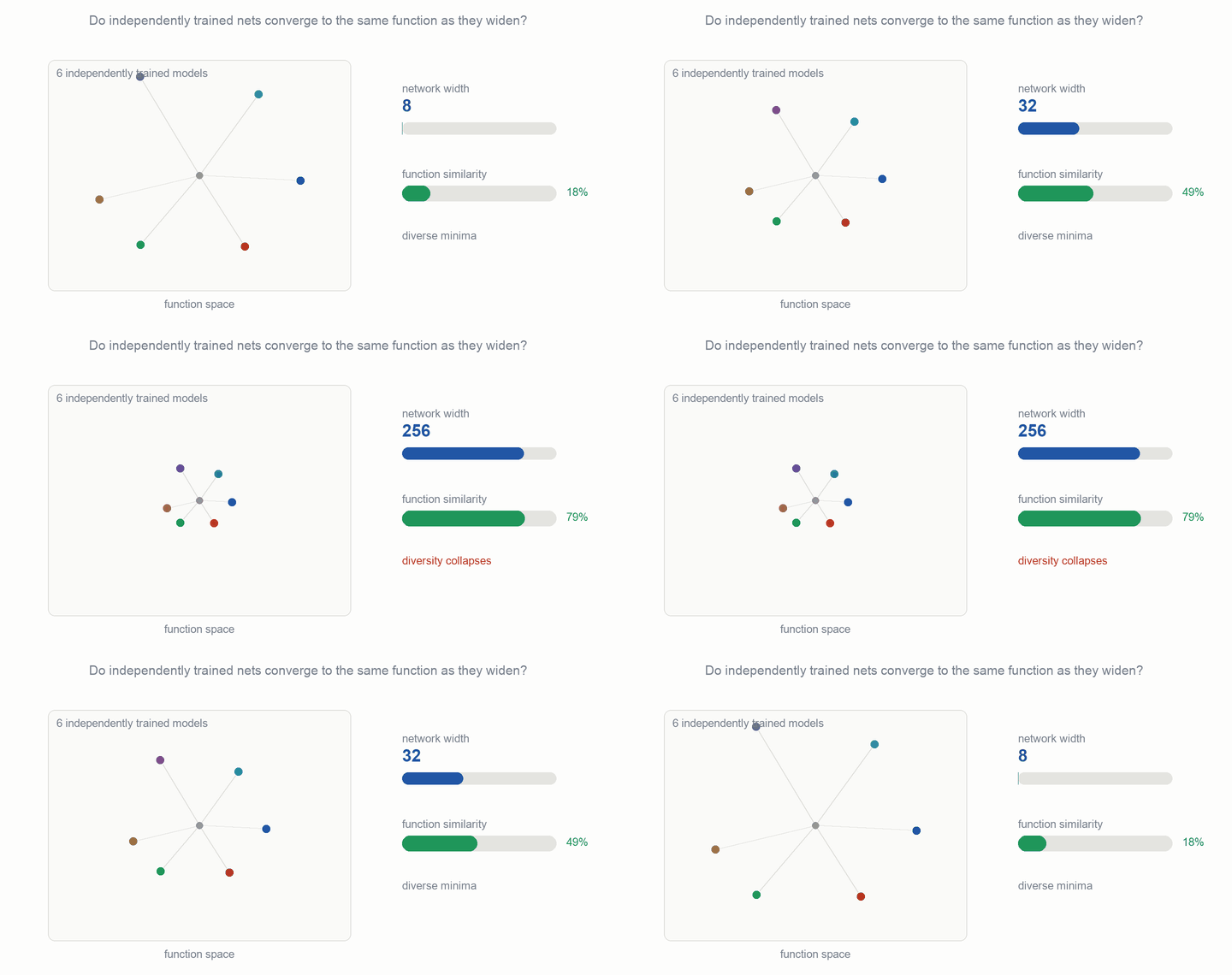
Reusable PyTorch experiments asking a single question: do independently trained neural networks become more functionally similar as their parameter count grows? Inspired by Fort, Hu & Lakshminarayanan, Deep Ensembles: A Loss Landscape Perspective.
The experiment #
A width sweep: for each network width, train several models from different random seeds, then measure how similar the resulting functions are to one another. As width increases, independently trained minima tend to collapse toward the same function (shown in the animation above), so ensemble diversity falls.
The sweeps run across MNIST (MLP), CIFAR-10 (CNN), and a CIFAR-10 patch-transformer, and reproduce several views from Fort et al.: diversity versus accuracy, function similarity versus parameter count, interpolation barriers between minima, and final weight/function similarity matrices.
The follow-up series digs into the sharper question:
When does overparameterization collapse functional diversity between independently trained neural-network minima?
Engineering #
-
A single CLI sweep runner driven by YAML configs (
scaling-ensembles-sweep). - Resumable by default — checkpoints are reused and per-model logits cached.
- Optional MLflow tracking of configs, metrics, checkpoints, and logits, with a cache that can restore artifacts from previous runs.
- A paper-plot generator and an interactive marimo app.
- Apple-Silicon (MPS) / CUDA / CPU auto-detection.