kalman-transformer 2024
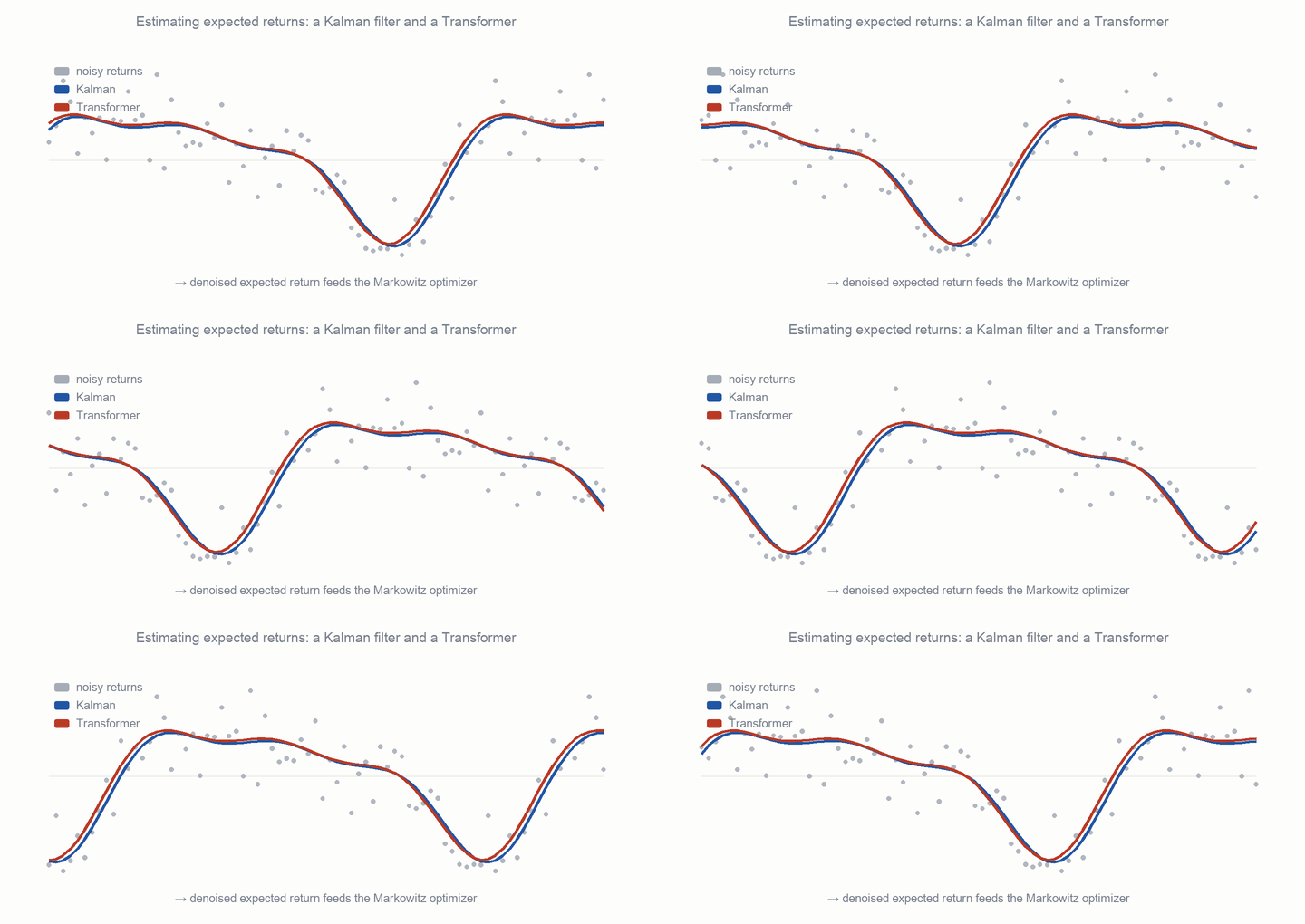
Can a Transformer play the role of a Kalman filter in portfolio construction? This project answers that concretely. It frames expected-return estimation as a state-estimation problem and makes the estimator pluggable: a classical local-level Kalman filter and a learned Transformer expose the same interface, feed the same Markowitz optimizer, and are compared in the same rolling backtest on the same data.
The pipeline #
Prices → daily returns → an expected-return estimator → Markowitz weights → rolling backtest:
- mean — historical sample mean (baseline).
-
kalman — a local-level model
μ_t = μ_{t-1} + w_t,r_t = μ_t + v_t; the filtered state is a denoised expected return. - transformer — an encoder-only Transformer trained to forecast the next return from a window of past returns.
Each estimator’s μ̂ and the sample covariance Σ go into a Markowitz
optimizer (max Sharpe or min variance), and the resulting weights are held over a
rolling backtest reporting Sharpe, volatility, drawdown, and the equity curve.
Why they’re interchangeable #
A local-level Kalman filter treats the expected return μ_t as a hidden state
observed through noisy returns (r_t = μ_t + noise); the filtered state is a
denoised expectation. The Transformer is the same idea made nonlinear and
learned — it maps a window of past returns to a one-step-ahead expectation.
Both answer “what return do we expect next?”, so they slot into the exact same
place in the pipeline (shown in the animation above).