graph-corr-embedd 2024
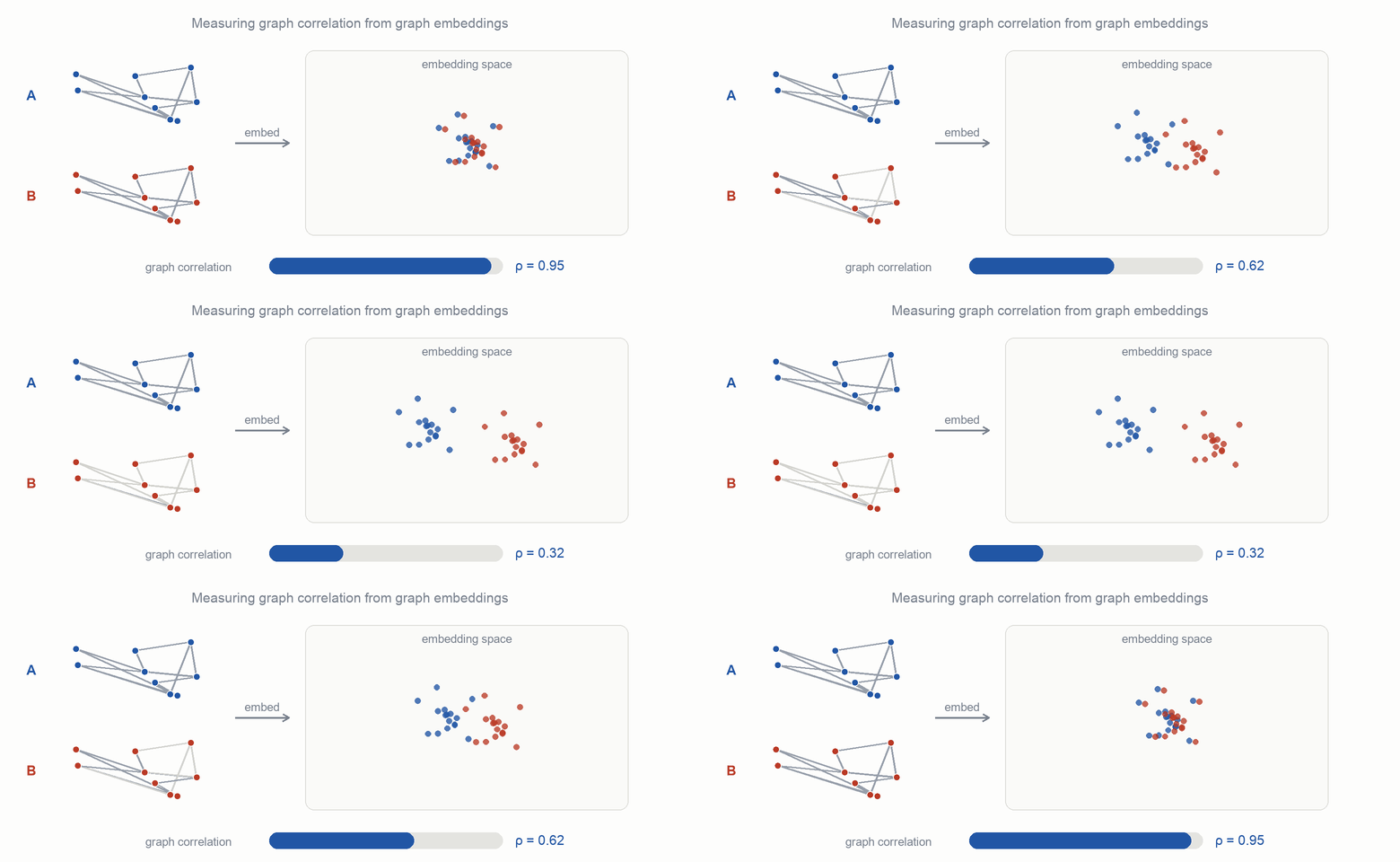
How do you measure the correlation between two graphs? This research project asks whether learned graph embeddings can capture graph correlation better than the classical graph-distance measures used in network science. It is a collaboration led by Daniel Oliveira.
The idea #
Each graph is mapped to a vector representation, and the correlation between two graphs is read off from the geometry of their embeddings: correlated graphs should land close together in embedding space, uncorrelated ones far apart.
- Embedding models — SDNE (Structural Deep Network Embedding, a deep autoencoder over the adjacency matrix), alongside stacked autoencoders, GCN, and graph neural-network variants, trained with reconstruction plus graph-correlation losses.
- Classical baselines — DeltaCon, the Frobenius matrix norm, Procrustes alignment (at several embedding dimensions), spectral distance, and Weisfeiler–Lehman similarity.
Experiments #
The methods are evaluated on simulated graph pairs with a controlled level of correlation, drawn from canonical random-graph models — Erdős–Rényi and Barabási–Albert. Sweeping the correlation lets you check how faithfully each measure recovers the ground truth, and where the embedding-based approach beats the classical distances.