flow-match 2025
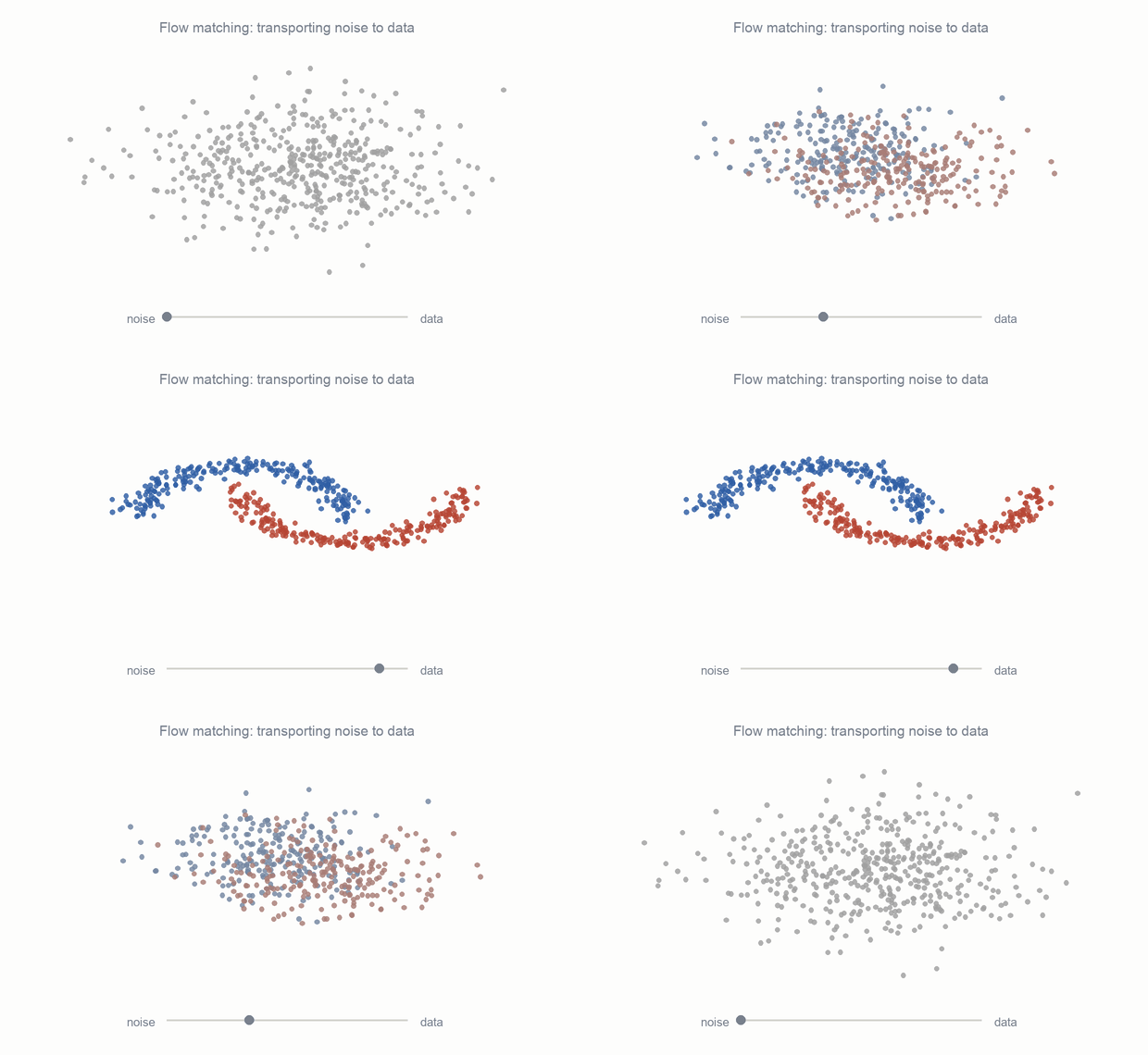
Experiments with the flow matching framework for generative modeling. Flow matching learns a velocity field that transports samples from noise to data by integrating an ordinary differential equation (ODE) — a simpler, simulation- free alternative to training diffusion models.
What’s inside #
-
A scikit-learn-like
FlowMatcherAPI:fit,sample, andsample_trajectory(which returns the whole path from noise to data). - A neural velocity field (configurable MLP).
- Multiple ODE solvers — Euler, Midpoint, and RK4 — to integrate the flow.
- Several 2D toy datasets (moons, and friends) for quick experimentation.
- Interactive marimo notebooks for visualization and intuition.
How it works #
Pair each noise sample x0 with a data sample x1 and define the straight-line
path x_t = (1 − t)·x0 + t·x1. The network is trained to predict the constant
velocity x1 − x0 along that path; at sampling time you start from noise and
integrate the learned velocity field with one of the ODE solvers. Higher-order
solvers (Midpoint, RK4) reach the data distribution in fewer steps.
The animation above shows exactly this: a Gaussian cloud transported into a two-moons distribution along the flow.