fisher-rao-ml 2025
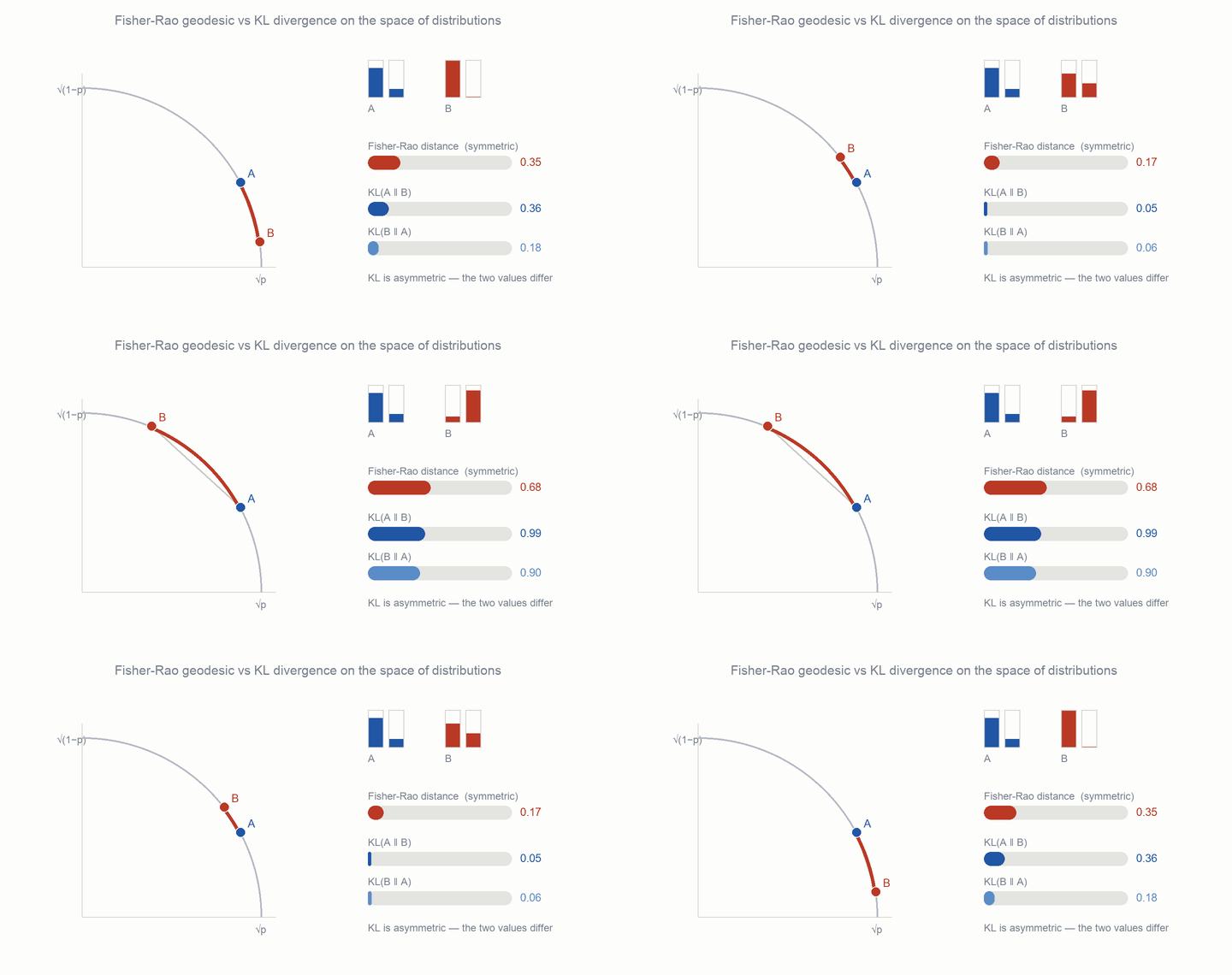
A rigorous empirical study of the Fisher-Rao geodesic distance as a replacement or complement to KL divergence in t-SNE-style affinity matching and variational autoencoders.
The geometry #
Probability distributions live on a curved manifold. The Fisher-Rao distance
is the geodesic (shortest-path) distance on that manifold under the Fisher
information metric — it is a true, symmetric distance. KL divergence, by
contrast, is a flat, asymmetric divergence: KL(A‖B) ≠ KL(B‖A). The
animation above shows both for Bernoulli distributions, where each distribution
maps to a point on the unit quarter-circle and Fisher-Rao becomes the arc between
two points.
What’s inside #
- A differentiable PyTorch implementation of categorical and diagonal-Gaussian Fisher-Rao distances.
- t-SNE and VAE training scripts that toggle between KL and Fisher-Rao objectives.
- Multi-seed, multi-dataset benchmarks (t-SNE robustness, a VAE β-sweep) plus targeted stress tests for regimes where KL’s unbounded asymmetric pressure may be a liability (noisy soft labels, distillation).
- Paired statistical aggregation — Wilcoxon signed-rank tests and Cliff’s delta — and an arXiv-style LaTeX report.
Honest findings #
The headline t-SNE result is negative-leaning: KL keeps a small but consistent advantage in silhouette-based cluster separation. The VAE workflow asks a different question — whether Fisher-Rao’s intrinsic geometry changes reconstruction, latent usefulness, posterior matching, and corruption robustness once each objective gets its own β tuning.